




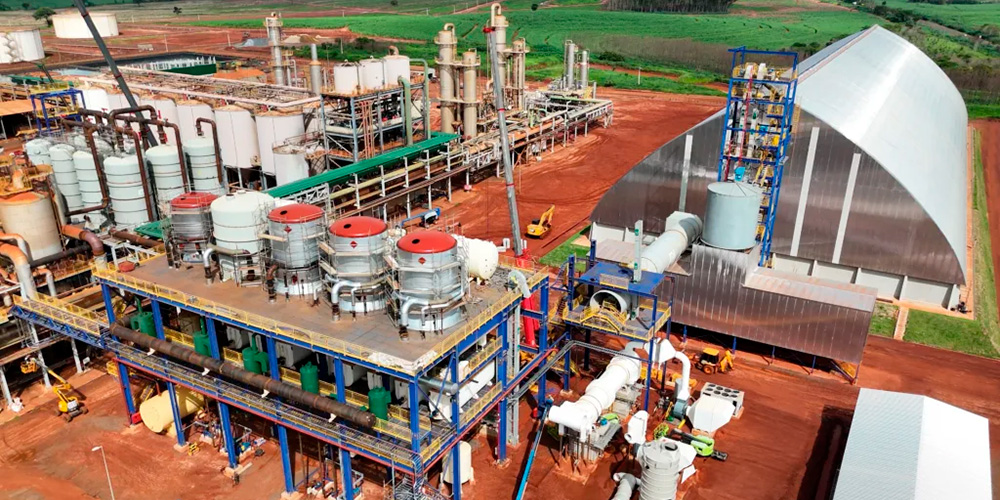
Santa Adélia’s Pereira Barreto Unit Sugar Mill Becomes the Focus of JornalCana Edition 355
The sugar mill at Santa Adélia’s Pereira Barreto Unit (UPB) begins operations in April.
A producer of ethanol since its inception in 2007, the Santa Adélia Pereira Barreto Unit (UPB) will start sugar production in April, marking the beginning of the 2025/26 harvest. With a production capacity of 18,000 bags per day, the plant is a long-standing dream of the Santa Adélia controllers, who also manage the main mill in Jaboticabal, São Paulo.
This project gained prominence after receiving approval from the company’s Board of Directors in 2023. Since then, the team of engineers and technicians has worked intensively to bring the sugar mill to life.
“This project is aligned with the company’s DNA, which focuses on technology and operational excellence,” highlights Helton Oliveira, Industrial and Engineering Director at Santa Adélia.
For Triniton Equipamentos, responsible for the evaporation and cooking equipment, as well as process integration and 3D modeling, the completion of UPB’s sugar mill is an emblematic example of how innovation, sustainability, and forward-looking vision can combine to create projects that transcend the industrial sphere.
“The scale of the new sugar mill project that Triniton is completing is a significant milestone, not only for the companies involved but for the entire sugar-energy industry,” emphasizes Marco Geris, Director at Triniton.
Project Management Led by Company Team
In an interview with JornalCana, Helton Oliveira provided details about the Pereira Barreto sugar mill.
How did the idea for the mill arise?
The UPB, a greenfield project inaugurated in 2007, already included in its master plan the construction of a sugar mill. In 2023, considering the growing global demand for sugar, the company decided to invest in the project. The global sugar market grows naturally at about 1.2% per year, with supply unable to keep pace. Brazil is one of the few countries capable of meeting this demand through increased production.
The sugar mill project was approved by Santa Adélia’s Board of Directors in June 2023, with a 20-month implementation schedule. The mill will produce VHP sugar.
How was the project managed?
The overall project management was carried out internally by professionals such as Juciano de Souza Ferrai, Corporate Engineering and Quality Manager, and Luiz Fernando Cremonez, Industrial Process Manager at UPB.
This team hired partners for the project, including Triniton, responsible for the full supply of evaporation and sugar mill systems, including design, equipment, processes, and 3D modeling, which allows for online project management.
Embedded Technology
How was the implementation carried out?
Assets from the Pioneiros Unit in Sud Mennucci (SP), decommissioned in 2020, were reused, with equipment undergoing retrofitting. The adoption of modern technology increased the capacity of the new mill at UPB.
With embedded technology, the project features energy efficiency (particularly in steam usage) and a lean workforce. For example, the operation of loading, storage, and dispatch in the 110,000-ton capacity warehouse will be handled by just three operators per shift.
When does the sugar mill begin operations?
Operations are scheduled to start in early April, with an initial testing phase of about 15 days.
The project assumes that the UPB sugarcane fields are still recovering, so the mill is expected to reach 120,000 tons of sugar in the 2025/26 harvest. By the 2026/27 harvest, the plan is to reach full capacity: 18,000 bags per day, or 170,000 tons per cycle.
Project Leaders: Juciano and Luiz
Electrical engineer Juciano de Souza Ferrai and mechanical engineer Luiz Fernando Cremonez have been fully dedicated to the sugar mill project since its approval in June 2023. They began with research and project planning and then oversaw process implementation starting in October.
Civil works began in 2024, with Juciano and Luiz leading the efforts. Typically, off-season periods (December to March) involve maintenance teams; at UPB, at least 200 workers have been deployed to the sugar mill area.
“I am proud to be part of this implementation,” says Juciano. “The mill is already part of Santa Adélia’s history,” adds Luiz. Juciano, who will celebrate 25 years with the company in June, started in the warehouse, while Luiz, with 15 years in the company, began as an intern.
Longevity in the company is common.
“Santa Adélia invests heavily in people development. The last industrial manager hired was in 2015,” recalls Juciano. “Since then, all managers have been promoted internally, including the directors.”
“Today, 100% of managers and 99% of supervisors in the industrial area are internally developed career professionals.”
Technological Features of the Sugar Mill
The mill is an open-concept facility, a new approach for the sector, focused on VHP sugar production. From the project’s inception, a digital twin model was used—a virtual representation of the physical plant. This model guides design, specifications, and procurement, helping prevent rework. It includes electrical layouts and process interconnections, as well as process flowcharts with embedded links for strategic and operational management.
Another highlight is the five-effect evaporation system, designed for high energy efficiency. It reuses steam throughout the process, offering low consumption, operational flexibility, and extra steam for cogeneration.
Expansion Plans
The 3D-designed project allows for future doubling of capacity to 36,000 bags per day. The necessary equipment models are already planned to reach this output.
Ensuring Sugarcane Supply
UPB has implemented drip irrigation on 1,076 hectares, with gradual expansion over the coming years, ensuring vertical growth of sugarcane fields to support increased mill capacity. Currently, UPB can process 3.5 million tons of sugarcane, with expansion planned in alignment with the Agricultural Master Plan.
Source: jornalcana.com.br


